

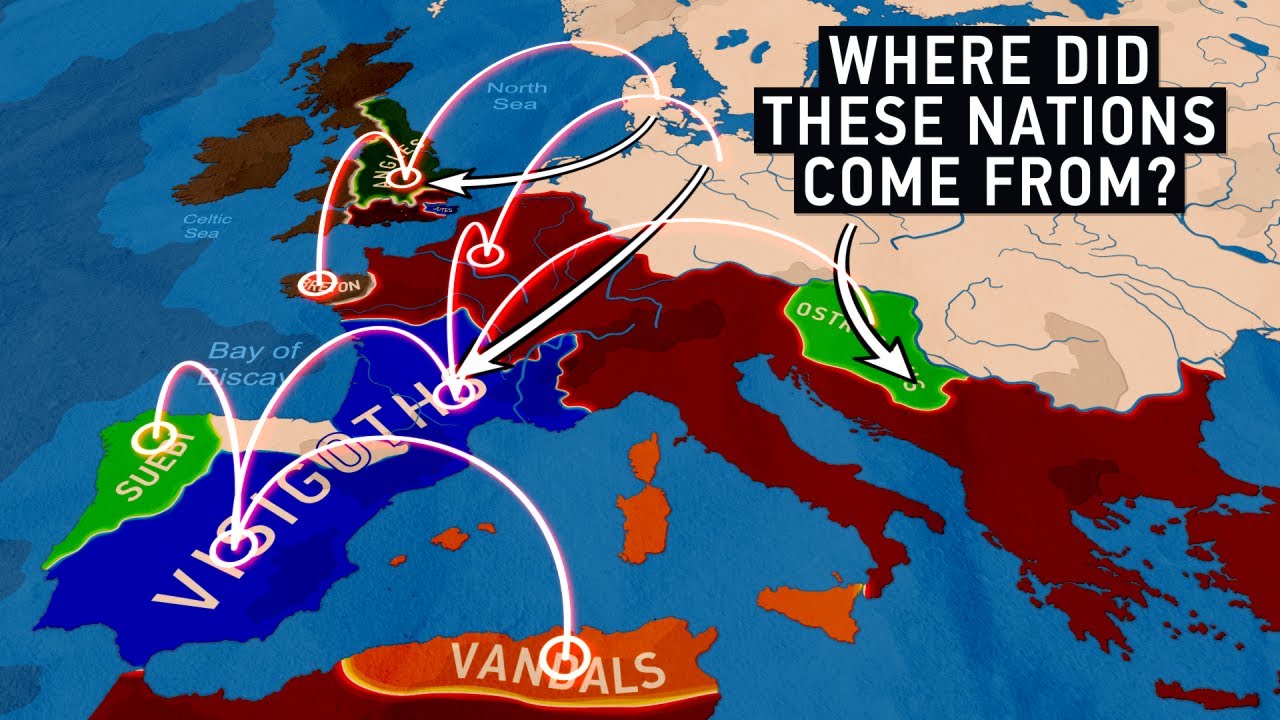
With out the Roman Empire, the world would not be as we all know it. Even it is fall influenced the lifetime of modern-day Europe. On this video, we are going to discover how European international locations shaped their borders, who actually have been the Barbarians and the way their confrontation with the Romans helped within the creation of Europe as we all know it as we speak.
supply
Proto-Bulgars are not Turks by ethnicity but Caucasians starting their journey from the Caucasus
Pretty sure Europe was born in Greece.
As far as I am aware, the first Europeans were not the Romans but the Hellenes (Greeks) the migrations started way before Alexander’s wars against Persia. There was a migration westward from present day Iran and Turkey westward. The Minonas were the first civilised Europeans followed by the Myceneans. You have missed an entire period and skipped straight to the Romans forgetting their predecessors…….THE HELLENES or GREEKS to the rest of the world. How stupid this video is…….like starting construction on the first storey without foundations……..Europes foundations lie in GREECE even Romans foundations lie in GREECE! Totally idiotic video.
🤣🤣🤣
🇷🇸🇷🇸🇷🇸🇷🇸🇷🇸🇷🇸
☠️☠️☠️☠️☠️☠️☠️☠️☠️
Nema tacnih podataka. Ovi podatci u videu su netacni tu akademici grese a kamoli video mejkeri pazote sto pustate
barbarian meant that he does not speak the same language, these Anglo-Saxons raised on Netflix sauce believe too much that our past is the Lord of the Rings
0:12 " Ancestors of the serbs" proceds to put ancient albanian territory as part of serbia
Wow man, what an incredible and educational work you did, congrats.
I like history, but you make me feel like I'm still are in the kindergarten. I got the big and superficial picture of that time in history.
Thanks for making me less ignorant. I'm a new follower.
And Arabs came to europe. Spain and a southern part of Italy ruled over 200 years ruled by arabs. Some of Italians and Spainards are carrying Arab blood.
Dacia was in ancient times the land inhabited by the Getae-Dacians, which were divided into a larger number of tribes -dacians , getae , etc. and occupied a territory comprised between the Tisza River (west), the Nistru River and the Black Sea (east), the Danube (south) and the Carpathians Forest (north). To the south, to the Hemus mountains.
The Dacian kingdom reached its largest expanse during the King Burebista.
The last Dacian king was Decebalus, when in 106 AC the Romans conquered a small part of the Dacian kingdom.
Romania is the ancient Dacia. The Getae-Dacians our ancestors.
The Dacians and the Getae – (from History of Herodotus, the 5th century BC ), are the Romanians ancestors. Paleogenetic studies .
The Romans called us – Dacians. The Greeks called us Getae . The Dacians and Getae are Thracian tribes, with different names. Modern historians attribute the name Geto-Dacian people.
–The Dacians are the only people of antiquity on which ancient documents, as well as archaeology, it indicates that the local. 8000 years old. Dacia, actual Romania was partially conquered by Rome in 106 AD. The name Romania comes from Rome capital of the Roman Empire and Romanus , i.e. citizens of Rome. ..
The 1866 constitution gave the country the name ROMANIA – from Rome, the capital of the Roman Empire, and Romanus, meaning citizen of Rome, part of Dacia being conquered by the Romans in 106 AD, becoming a Roman province.
You guys are full of shit. Year 106 emperor Traian conques parts of actua Romania in so called DACIA. You so called experts don't even mention Geto-Daciens. Miceal Ledwith, former advisor to Pope John Paul II: «The Romanian language is not a Latin language, but the Latin language is a Romanian language!» … and you guys skipped that like it was nothing. Really? You guys suck!
Why No mention of Islam taking Spain?
Serbs are more than 7000 years on same place. Read about Vinca Civilization and Lepenski Vir where civilization is born in Europe.
The Greeks referred to them as barbarians not the Romans…in fact Romans were also considered barbarians! There is this ancient greek proverb: Πας μη Έλλην βάρβαρος which translates : All not Greek are barbarians. Romans, or the Roman empire as historically portrayed, didn't exist yet when the Greeks named them barbarians
Propaganda !😂
Compare with this people putin is a child'splay
Its invasion not migration
The south of Hispania was occupied by bizantines during 80 years when Justiniano ruled the empire. Called Spania Province by bizantines did still from 546 ruling Hispania Theudis to 624 with Suintila in the Toledo throne. During this period Leovigildo get the throne of Spain ( 569- 586 ) and he is considered the first spaniard authentic king.
Vinca , Spartans , Serbs. End of Story.
Proud Serb here ! Although, the first European civilization arose in the Balkans. We Serbs, Croats, Bosnians, Macedonians and Slovenes are descendants of Vinča civilization.
So much nonsences.
How can anybody proof all that? What sources? Honestly i think that's impossible. Come on we're talking about 2000 and more year's. I'm shore mostly is nonsense.
They found in albania an 8500 years old city so does this need a video also
Your opinión is yours and yours ONLY…
AND SPAIN'S HISTORY IS Based on TRUE FACTS…
AND THAT THE GOTHS (VISIGOTHS …WESTERN GOTHS) CREATED THE GOTHIC KINGDOM OF SPAIN IN THE 5th,Century a.d. IS A TRUE HISTORICAL fact.
As it's True also that in the 8th,Century a.d. Swedish Vikings created the KINGDOM of the Kevian RUS….
FROM WHERE RUSSIA STEMS FROM.
THUS BOTH COUNTRIES SPAIN AND RUSSIA OWE THEIR INDEPENDENT KINGDOMS CREATION TO THE GOTHS OF SWEDISH ORIGEN…
WETHER YOU John John like It or Not…
😮😅😊
THE GOTHS that invaded and settled in Hispania weren't "a small minority " at all.
Were they so they would not never had conquered the Ibero Román population which at the time were roughly 5 million STRONG…
When the GOTHS ARRIVED IN Hispania they had been living in the Román Empíre for a long time so they ALREADY spoke a Sort of Vulgar Latín…
Still innumerables Germanic WORDS stuck in the different Languages of Spain…
e.g. LAGAR..(where beer, wine ,cider etc ,etc are kept)
LATIGO…(MEANING Whip)
Ya ya expression..(MEANING ja ja)
Y es…( MEANING It is )
Burgo…(MEANING Town)
Yo…. as JEG in modern Swedish.
Barruntar…(MEANING to think as in Germanic Warrunt).
Liderar…(To lead)
Bregar…( To work…to struggle…to fight)..
THE list of Germanic WORDS in the Languages of Spain are endless.
THE GOTHS created Independent Spain…
It's KINGDOM State as we know It today
( MEANING I)
this lookes like AI made it with so many inaccuracies
A srbi šta je sa njima. Spominješ slovene a šta je sa srbima sarmatima. Oni su starosedeoci balkana.
The Magyars did not call their settled land Hungary. They still refer to it as Magyar. The Catholic Church called it Hungary to associate them with the Huns.
Nonsense video, there was a massive population of celts in Britain before the saxons came over
Contemporary anglo saxonic UK have to thank to HUN TÜRKS . They pushed population migration towards English islands and England had established 😂😂😂
THATS BULL SHIT, THE GREEKS HAVE BEEN THERE BEFORE THE ROMANS, THE GREEKS BEEN THERE FOR OVER 200, OOO YEARSSSSSSSSSSSS TAKE THAT<<<<<<
You're off to a wrong start… Before the Roman Empire there was ancient Greece or Macedonia of Alexander the Great.
You have a very vivid imagination, but you don't have the slightest idea about history. So you should turn off this channel because you are misleading people, causing confusion and harm.
В днешно време всеки интерпретира историята както си поиска. Повечето неща тук са грешни.
How where the world before this? Did peoples used to migrate a lot?
Washington White House VERSION
About the Cimbri, when they began their invasion in the II century BC Gaul (and many other territories) wasn't still fully conquered by the Roman Republic. What the map shows is the extent of the Roman Empire at its peak, some 300 years later.
Germans??? portable Judes (North part of jutland), Anglos (mid part of Jutland) and Saxons Southern part/North par of what to Day called Germany.
Atila: Marry my sister, bro!
Flavius: tf?
Atila: starts a war.
A nice story, but 80% is fantasy. Dates do not add up, it's a mix of ideas, so many nations are not depicted there… like Dacians, which were north of the Danube all the time… Wallachia, Transylvania, Moldavia were their territories. It's like you are presenting the actual Europe and there are just Germany, France, Italy and Greece… no other countries.
not even funny …